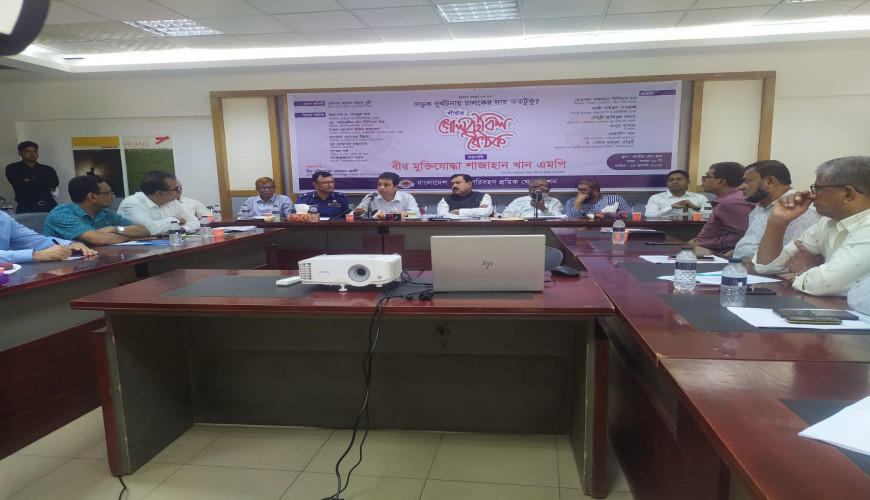
Transportation is a precious profession. National economy, safe travel, transportation of goods and workers dignified life are linked in a source. Transportation system is much like the blood flow in the human body. Just as no part of the body can function if the blood flow is stopped, similarly, if the transport system is stopped, all the sectors including agriculture, industry and services of the country are bound to stopped. With an average of 30 million passengers transport every day, about 100 millions tons of goods transport a year, more than 43 lakh vehicles and more than 7 millions workers in this transport sector. Thousands crores of money are invested to buy vehicles, every day hundreds crores taka in rental income and thousands of crores of government annual revenue is the road transport sector. More than 10 lakh people from many sectors including motor mechanics, counter masters, motor parts traders, hotel restaurants are associated with it.
Now a days road crash have scared everyone. As much as the government, authorities, politicians, journalists, intellectuals, lawyers and other professions are concerned about the punishment of the road crash but the efforts to eliminate the cause of the road crash are not as visible. we looked at only one symptom of why road crashes happen and That is - “The responsibility of the road crash lies with the driver”. The rest of the causes are always left out of consideration. As a result, people from other sectors of the society have a negative perception about all those involved in transportation.
We look at the only symptom of why road crash are happening in our country, that is all the responsibility of road crash is only on the driver. The sector is always at the center of discussion with illiterate, uneducated/under-educated transport workers, Powerful owners, illegal toll and helpless commuters. Road transport is connected including workers, owners, BRTA, commuters, pedestrians-general public, road management-infrastructure, driver training, employment rules, accident investigation process, road construction, design and operation, traffic police, highway police, law-courts etc. But after a road crash, nothing comes into discussion except the driver. The saddest thing is that the rights and problems of millions of road transport workers are not discussed. As a result, the real problems and potential aspects of road crash have remained out of the notice of other sections of the society.
Background: Child Labour
Due to the increasing process of urbanization in Bangladesh, child labor especially in the transportation sector has been observed as a vital social challenge. Children aged below 18 are found in all types of vehicles especially in public transport like buses, mini-buses, trucks, human-haulers and so on. Young children are seen hanging from the door dangerously and help drivers to make way through congestion. Sometimes they collect fair from passengers or help them to carry load. In most of the cases, those young children get involved in this profession for various reasons such as poverty, family crises, domestic violence, be in debt and so on.
They have to leave their beautiful future and get involved in this sector as a helper, conductor or doorkeeper. Most of them believe that by doing this one day they will be a driver and secure a job. They confined their thinking in the terminal and grow up messily. These children spend their whole day in a bus or truck with the driver and most of the cases they have to spend the night in the terminal or again in the parked vehicle. Sometimes they ask the driver to show them how to drive and at the end of the day they get chance to park the bus or truck. Usually, this is the common procedure or pipeline to become a driver in Bangladesh transport industry. Which is why, various problem exists in this system.
First of all, they are deprived of traditional basic education. Education is the basic right of every citizen though not ensured for those terminal boys. For this reason, they grow up with a tiny future and their dream is limited to become a driver. If they get the basic education they might be able to think beyond the terminal life. On the other hand, by ensuring basic education, the nation will get some educated drivers.
Secondly, lack of awareness is another common phenomenon of those children. They grow up as a driver without knowing the basic traffic rules and regulation, traffic laws, the meaning of traffic sign and road marking, proper skills and so on since they are not in a position to get involved in programs based on this issue.
Thirdly, lack of proper training to develop their skill is another dominant factor. Many children are engaged in different tasks besides being a helper. Such as cleaning, basic maintenance, tyre rotations, major adjustment of various components and so on. These types of activities are not only hazardous but also tough to manage. In most cases, they get injured while doing these tasks. Very little effort has indeed been done yet for those terminal boys though it is a very time-demanding issue for now for a safe and disciplined transport system in Bangladesh.
The aim of this project is to build a social movement for safe roads by highlighting the real problems and possibilities of this large number of workers serving in the road transport sector to the people of different sections of the society. We working to improve the safety and awareness sense of security of the workers in their workplace, so that they Understands the importance of responsibility.
None of our parents (including transport workers) encourage their children to become bus or truck drivers. Every parent encourages their children to become a pilots (airplane pilots) or captains (ship drivers) but not bus or truck drivers. Almost all of these more than 5 million transport workers and 1 million motor mechanics have come to this risky profession either poverty or no other way to find work. For near about 100% of workers are illiterate. Although a large part of them are son or relatives of transport workers. But now the transport workers try to educate their children and discourage to work as drivers or transport.
Transport workers are:
1. Driver
2. Supervisor/ Conductor
3. Helper
4. Manager or Care Taker
5. Counter Master
6. Caller Boy
7. Cleaner
At the teen age each of them roaming around the terminal, fetching tea and snacks to the bus or truck workers, washing the bus/truck and listening to the orders of the master (driver) they become as a driver. Some are counter masters, collar boys or cleaners. The lack of life has drawn into transport workers.
Driver :
From bringing each of the workers learns to control the vehicle by following the orders of the Ustad (Driver), listening to the commands of the Ustad (Driver) and through this work one day become a professional driver. As a result, the drivers of our country skilled by the practical education of how to control the vehicle and take it to the destination. In our country, the government spends 20 to 30 lac taka per person to create skilled manpower for a doctor, engineer, bureaucrat, banker or any class of profession. But the government does not have to spend a single taka to create a driver. As a result, our drivers are not drivers under government management. There is no provision of education and training for them.
Supervisors/Conductors:
Adolescent boys who have little education i.e. after completing minimum primary level and come into transport are given the opportunity to work as conductors as they have minimum education and can count money. Now some educated boys are working in public transport as conductors or supervisors but most of them leave for other jobs.
Driver's license or license issue:
To renew a license, it costs 2,725.00 taka as government fee and 900.00 taka for dope test. But a worker is forced to spend a minimum of 12,000 to 15,000 taka for a new license and 10,000.00 to 12,000.00 taka for renewal. Those who are working as instructors in BRTA with the certificate, doing business by establishing driver training centers or schools, they mainly do the work of issuing driver's license for more (minimum 12,000 to 15,000) contracts. The whole process was completed by those instructors, brokers and corrupt officials of BRTA. Mainly because of their lack of formal education and the prevailing word among the workers that the brokers (instructors-employees-officers) do not pass the field test, the fact is, the workers are forced to obey the brokers. As the process of obtaining license is not easy for the workers, they are forced to procure licenses through unethical means and change the driving category. As a result, workers become drivers without knowing the basic rules and regulations of traffic, traffic laws, meaning of traffic signs and road marking etc. even if they have skilled.
Workplace of Transport Workers:
The total length of our national highway is 3 thousand 812.78 km, the length of regional highway is 4 thousand 246.97 km, the length of district road is 13 thousand 242.33 km, the total length is 21 thousand 302.08 km. This 21 thousand 302.08 km road is from one end of the country to the other end of the transport workers' workplace. If a driver goes to Panchagarh with cargo from Chittagong port, it takes 16 to 18 hours. There is no guarantee that a worker will return dead or crippled during this period. Our Prime Minister Sheikh Hasina has said that a driver should not drive for more than 5/6 hours to reduce road accidents.
Road transport is one sector where even the directives of Hon'ble Chief Minister or Hon'ble High Court are ignored. For highway drivers and assistants, there is no rest facility, no toilet facilities on the road during this long period. It can be said that the bus or truck is the place of work as well the place of residence. Many times transport workers also lose their lives in the hands of robberies on the way. In Dhaka city a driver takes a bus/truck in Dhaka city in the morning and returns at mid-night.
They have to sit in the driving seat in daily based agreement with the owner. To collect the money of that contract one has to drive more than 15/20 hours a day. There is no provision of toilet facilities for them in Dhaka city. There is no car parking facility.On the same road, high speed, medium speed, slow cars, bullock carts, thela carts, Nasimon, Karimon, Bhatavti etc. ply. Road quality is also bad.
Security :
Transport workers do not have to give any kind of employment letter, contract to the owner, only join the work on verbal agreement. There is no such thing as job security because the workers do not have appointment letter, identity card or service book etc. A driver with 2 years of experience earns the same salary as a driver with 20/25 years of experience. At the age of 55 to 60 years, workers are at the risk of job loss and its also increases day by day. That is why there is no discipline among the workers.
Death at Work Places:
In the research of Bangladesh Institute of Labour Studies (Bills), we see the picture of the death of transport workers due to road crash in the workplace in the last eight years (2015-2022) - 3819 workers were died in the last 12 years from 2011 to 2022 in the transport sector. In 2022, 499 workers were died. Besides, 513 people died in 2021, 348 people in 2020, 516 people in 2019, 424 people in 2018, 249 people in 2017. Statistics on the number of workers dying or becoming paralyzed due to cardiac arrest or heart attacks at work and the number of workers injured and disabled at work are not available in the Bills data and are not available anywhere.
It is very sad that only because of propaganda type of newspapers or electronic media of transport workers are dying on at work in road crashes and are also responsible for the death of others. Most of the road crashes in the media, newspapers, television etc. are headlined as "3/4 lives were taken away by a bus or truck" or crushed by the wheels of the bus/truck etc. and the news does not mention any investigation or constructive report as to why the road crash happened. On the one hand, negative perception of road transport workers has been created among the people as the news has given priority to the reckless speed.
Road condition:
To upgrade the Dhaka-Chittagong highway to four lanes, about 18 crore taka per kilometer has been spent. This highway, known as the lifeline of the economy, became fragile within just one year of its construction. Again, about 21 crore taka have been spent per kilometer to make the Jaidebpur-Mymensingh highway four lanes. The same problem occurs on this road. However, both the highways were built with utmost importance by the Directorate of Roads and Highways (RHD). Road Transport and Bridges Minister Obaidul Quader expressed his anger many times after seeing the condition of Dhaka-Chittagong highway in such a short period of time. If the roads are destroyed in a short period of time, the state is wasting a lot of money.
The country has one of the oldest laboratories for researching, improving or maintaining roads. The full name is 'Bangladesh Road Research Laboratory-BRRL'. Surprisingly, there is no researcher in this research institution. It basically works as a laboratory here. All of the allocation for research is spent on sample testing, lab management and equipment purchase. The examiners are responsible for running the lab. The main function of road laboratory is to verify the quality of construction materials or products once before construction starts. After that, verifying whether quality and correct quantity of materials are used as per the contract.
Research new topics. But none of that happens here. Only after getting the job, the contractors take their responsibility to test the sample of construction materials. Sometimes not all products can be tested in RHD laboratories due to lack of capacity. Tests are brought from BUET or various public and private laboratories. Even the materials of many large projects are tested in the contractor's own lab. Again, even if there is an opportunity to check the quality after the construction of the road, it is not happening. As a result, the expressway became derelict.
Road research sector has not been allocated in the financial year 2018-19. In the fiscal year 2019-20, 50 lakh taka has been allocated but 32 lakh 85 thousand taka has been spent. Not allocated in FY 2020-21. In fiscal year 2021-22, 32 lakh 39 thousand taka has been allocated but 23 lakh 68 thousand taka has been spent. In the last fiscal year 2022-23, Tk 20 lakh was allocated but Tk 7 lakh 86 thousand was spent.
2 crore 13 lakh rupees have been allocated in the research sector in the road quality control and training department in the last five financial years. 50 lakhs in 2017-18 financial year, no allocation in 2018-19 and 2022-23 financial years. 85 lakh in 2019-20 financial year, 60 lakh 82 thousand in 2020-21 financial year and 17 lakh 61 thousand in 2021-22 financial year. In the financial year 2021-22, Tk. 25 lakh has been allocated to the consultancy sector.
As for roads and highways, there is little research allocation beyond salaries and allowances of laboratory officers across the country, including Mirpur. In the seven years from 2016-17 to 2022-23 financial year, the allocation for research and development was about Tk 20 crore.
In the fiscal year 2021-22, only under the Directorate of Roads and Highways (RHD), 23 thousand 281 crores have been spent on the construction of roads and bridges. And in the last 10 years, 1 lakh 10 thousand crores of rupees have been spent in this sector. An average of 2000 crore taka is spent on road maintenance every year. However, according to a survey by the World Economic Forum in 2018, Bangladesh was ranked second among Asian countries in terms of poor road conditions. The International Monetary Fund (IMF) released a report in May 2022 on road quality and average speed. According to the report made on the roads of 162 countries, the average speed on the roads of Bangladesh is 41 kilometers per hour.
Engineers say that the investment is made on the assumption that the new road will last for 20 years. But the roads and highways need repair within three to five years of construction. Even some roads are deteriorating fast. After so much investment, why the condition of roads in the country is bad, this question may come. And the main reason for this is the use of low quality materials, not providing proper materials and defective construction system.
But RHD has laboratories to ensure quality materials and verify them after construction. The Local Government Engineering Department (LGED), another agency in charge of road construction, also has a laboratory. But these laboratories exist only in name.
Information from Planning Commission's Implementation Monitoring and Evaluation Department (IMED) says that a large part of the Roads and High Ways (RHD) department has various defects in its roads, which could not be resolved in the study. A survey titled 'Pavement Failure Investigation' was conducted by the Roads and High Ways (RHD) department to check the quality of the pitch (pavement) in the financial year 2016-17. 18 roads were selected in the survey sample.
Analyzing the results, it can be seen that almost every road has undulation problems. Based on the quality of the roads, they are divided into five categories of good, passable, poor, bad and very bad by the Roads and High Way (RHD) department. If any of these roads have undulations, it falls in the list of 'bad' roads. So research says that every road we have is bad. Source- Daily Prothom Alo
Bangladesh Road Transport Authority (BRTA):
Bangladesh Road Transport Authority (BRTA) was constituted by Chapter 2 of the Motor Vehicles Ordinance, 1983 (Amendment-1987) and has been functioning since 1988. BRTA is a regulatory body for ensuring order in the road transport sector and road safety in Bangladesh.
BRTA and Management and Control Authority. BRTA operates under the Ministry of Road Transport and Bridges[1] to fulfill the objectives of the Motor Vehicles Ordinance, 1983. The chief executive of the organization is the chairman, who acts as per the rules of the organization and as per the direction of the government.[2]
Activities:
1) Regulating road transport by regulating motor vehicle operations, issuing permits, fixing bus and truck fares.
2) Regular activities like issuance of driving license, fitness certificate, registration certificate and instructor license.
3) Motor vehicle registration test.
4) Organizing and conducting workshop seminars to impart information on safe driving and traffic regulations.
5) Conducting research and development for the development of concepts and methods of safe road transport and traffic systems.
BRTA are not fulfilling their responsibility properly. If you look at their activities, you can see that they control the driver's driving license, the speed of the vehicle, etc. In reality, BRTA has become an arena for a syndicate of corrupt crooks. Every day there is a bribe business worth billions of money. The proof can be found only by taking into account the wealth of each and every employee-officer there. The issue has also appeared in various periodicals.
Mental Health of Our Transport Workers:
Transport workers getting into heated arguments or quarrels with public transport passengers has now become a routine matter. Unplanned and broken roads, overcrowded vehicles, mismanagement of traffic control, underdeveloped communication system, lack of law and order, movement of slow vehicles along with high speed vehicles on the same road, competition for getting passengers, traffic in the opposite direction, parking on everywhere, walking at will, pressure to pay various types of illegal tolls on the road, etc. When he works as a driver or driver's assistant or fare collector on the road, his mental state is usually very excited, hot and angry. And by staying like this day after day, their mental distress becomes permanent.
Studies have shown that commuting more than 30 minutes a day can lead to depression, anxiety and social isolation. The peace and contentment of the mind is gradually going down. If such a situation occurs in a journey of more than 30 minutes, the condition of transport workers becomes deplorable due to various problematic communication systems and the effect of mental stress in our country.
Paulo Ruigrasso and his colleagues conducted a study on bus and rickshaw drivers in Lima, Peru in 2014 and found that due to continuous noise pollution, long-term work pressure, mental stress, social isolation, lack of sleep, etc., bus and rickshaw drivers are more likely to suffer from complex mental illnesses such as drug addiction and schizophrenia. is at risk.
Since most of the time drivers have very little income compared to the hours worked, the urge to earn enough money often creates stress. So they feel pressure to increase the amount of earnings by working overtime. Thus, an immediate response in a person is depression, fear, anxiety etc.; Similarly, intense depression and long hours of work also create the problem of burnout. Their behavior is characterized by irritability, bad temper with others, little excessive anger etc.
Professor of Psychology Department of Dhaka University. According to Sarah Diba, transport workers are often liable to spend long hours on the road to fulfill family responsibilities and are socially isolated. As a result, they don't get the normal opportunity to process their emotions. As transport workers are bound to work under more stress, the natural process of mental instability causes them to experience more stress, thus the natural process of human anxiety exerts more stress on them and they take drugs to reduce this internal ambivalence. He chose the path of mitigation. And slowly this way of getting this quick mental peace binds them in the strong chains of drug addiction.
In the case of our transport workers, such overtime workloads, irregular work routines, limited opportunities for rest, and long periods away from personal and social support relationships make it impossible for them to maintain a normal state of mind. When such a mentally weak or vulnerable or endangered person sees while driving a vehicle that others are blocking or overtaking the path of his vehicle without obeying the rules, he becomes reckless and desperate with frustration, confusion and anger. In accidents where mechanical fault or environmental influence is minimal, such reckless mental state of the driver has been proven to be the cause of the accident.
In a study of bus and truck drivers in Los Angeles, USA, Biland and Brent (2017) showed unexpectedly high levels of domestic violence among drivers who work heavy traffic and long schedules. That is, these drivers are not only 'risky' for an immediate accident; Rather, they gradually become a threat to themselves and their family members in their personal lives.
Long hours of work sometimes lasting 16 to 20 hours or more each day, irregular work routines, limited opportunities for rest, long periods of isolation from family and social ties are common in the lives of transport workers in our country. As a result, the resulting mental state is not only related to road accidents, but also severely affects their personal and family life.
Economic and Social Life of Transport Workers:
About 85 percent of the total workers in the country are day-to-day workers, i.e. workers in the informal sector. And the largest and most important of these informal sectors is road transport. Transportation workers still work when everyone is told to stay home during a natural disaster or special situation. In the Corona crisis, the transport workers have risked their lives in many cases, including emergency transport such as food, medicine, agricultural products, export goods, ambulances. In most cases the authorities did not provide them with the necessary health protection materials but the transport workers worked.
On March 8, 2020, the first corona infection was detected in Bangladesh. After this, a general holiday was declared across the country to prevent infection and reduce crowding. At the same time, road transport was announced stop across the country. As a result, at least 50 lac transport workers across the country became completely unemployed. When the wheels of the vehicles turned, the wheels of the family turned, as soon as the wheels of the vehicles stopped, the wheels of the family also stopped.
Millions of transport workers who have become unemployed due to the Corona disaster have been forced to live a miserable life. Although relief has been provided to many sections of the society, no relief has been reported in the transport sector. On the other hand, the transport workers had to protest on the streets for a little cooperation in different parts of the country. The Corona disaster has shown that the transport workers are separated from the society for some invisible reason.
If all the workers have work, their family, their daily expenses can be maintained, if not, they cannot. None of them have any savings due to very low income. Accumulation is the active body. As long as the functional body is active, the income is active.
If one gets sick or crippled by an accident due to any reason, one has no choice but to live by directly helping others or begging. If you are injured in a road accident, there is no one to treat you. Both the owners or the union cooperate with a maximum of 10/15 or 20 thousand taka at one time, but most of the workers do not get that, because there is no one to contact the owner or the labor union on time. Also economic incapacity, personal resentment, dislike, reluctance etc. of many leaders. And in case of a road crash case, in most cases, the employer directly blames the worker for the road crash as others and does not bear any responsibility for the cost of the case. A single case made his life financially crippled and miserable. There is no housing for these workers, no pension for them in old age, no laws to protect the workers.
Driver's Liability in Road Crash:
Driving is a matter where all the senses such as head, eyes, ears etc. have to be kept alert at all times. A bus or truck moves more than 50 feet per second when it goes at 60 km/h. As a result, a moment of inattention can lead to a terrible accident. That is why driving cannot be compared with other professions. When transport workers move the vehicles, they have one foot in the grave and one in the jail.
No driver, be it a bus or a truck driver, will deliberately hit someone, as it will also endanger his own life. If there is a conspiracy to kill people by pushing, then there must be a driver like a suicide bomber. These bus or truck drivers are working, they would not naturally get involved in such a terrorist project.
No transport worker can drive a bus/truck even with the assurance that he will return safely. When the driver is driving, his head, eyes, nose, ears, hands, feet all have to be alert at the same time. It is a very challenging profession. And no driver wants, under the wheel of his vehical, people, far away, any snake, frog, dog even a cat dead or alive.
But people from all walks of life strongly believe that only the driver is responsible for road crash. No one wants to think that failing a student means failing his teacher, the syllabus, or even the education system. Everyone says that when the car is on the road, the safety of the passengers is the responsibility of the driver, but no one thinks about the safety of the driver. No one needs to know that. As every driver knows, in any road crash the most likely person to be injured or killed is him or his helpers. Road crash are usually caused by mechanical failure, road failure, driver or pedestrian negligence.
On March 19, 2023, 19 people, including the driver, conductor helper, lost their lives in a bus accident of Imad Paribahan on Dhaka Bhanga Expressway. An investigation report by Buet's Accident Research Institute blamed the accident on road conditions, substandard wheels and road conditions. However, the reasons for the accident reported in the media are as follows-
Over speeding, reckless driving
Tire burst
Fatigue and drowsiness of the bus driver
Falling off the railing of the bridge
Gear/brake clutch
Driving with a middle class license
Pedestrian hit
unfit bus
Wet roads, etc By referring to the news.
Over-speeding was widely blamed for the accident but the BUET investigation found no direct link to the road crash and based on speed tracking data, the driver was not over-speeding. The probable cause of the accident was due to front tire burst. And majorly infrastructural deficits have been identified as the cause of many casualties. Research says the driver was driving at 79 km/h at the time of the crash and was paying attention. He was driving at a steady speed of less than 90 km/h. Logically, very expensive access controlled expressways should have a speed limit of more than 80 km/h.
On August 13, 2011, on their way back to Dhaka from a film shooting spot in a village of Manikganj, famous film director Tarek Masud and five people, including the head of ATN News, Mishuk Munir, son of Shahid Buddhijivi, playwrighter Munir Chowdhury, lost their lives in a road crash. Tariq Masood's wife Catherine Masood and artist Dhali Al-Mamun were also injured in this road crash. A documentary called "Social Crossfire" was also produced based on the BUET investigation report of the road crash.
There too the investigation report of BUET's Accident Research Institute says, “The curve of the road where the crash occurred was unscientific. There was trouble in road construction, sign-making. Reckless speed has been mentioned in the reports of police and government investigation committee along with newspapers. Although Jamir's bus was said to be running at a reckless speed, in reality its speed was within the controlled limit. According to research, the speed of the Chuadanga deluxe bus was 35 km/hr. We usually focus on only one symptom of why road accidents happen in our country. That is, all the responsibility of the accident lies with the driver.
Road Transport Act (2018) :
If punishment is provided with comfort and safety in the driver's mind, caution increases, otherwise constant anxiety is created. It increases the risk. The Road Transport Act 2018 has come into effect from 1 November 2019, bringing a temporary end to the mutual blame for a long time. After the Road Transport Act was passed by Parliament as Act No. 47 on 18 September 2018, it received the assent of the President on 8 October 2018.
Ignoring the advice of trade unions and experts associated with road transport, the government fixed the date of implementation of this law from 1 November 2019. This Act has been formulated by arranging 54 definitions and 126 sections in 14 chapters with the aim of order and fair management on roads.
Everyone is worried about road crashes, loss of life, loss of property, wastage of time etc. Out of the 16 crore people of the country, at least 3 crore people use some form of vehicle for daily commuting. Small, light, medium, large, heavy vehicles are used every day for transportation of agricultural, industrial, service sector products, construction materials etc. in the country. As a result, road safety deserves everyone's attention and consideration.
According to various researches and expert opinions, on an average 20 people die and 50 people are injured in road crash every day. The annual financial loss due to these road crash is about 32 thousand crore taka. For these reasons, a scientific and democratic road transport policy is very necessary to establish order and safety on the roads. According to experts, the law focuses more on crashes and punishments. But equal importance needs to be given to discipline, safety of passengers and safety of workers. Accident also needs to have a definition. Accidents cannot be punished. We all want a democratic road transport law that not only ensures road order and passenger safety but also legal protection for workers.
The law will deal with corruption in government institutions including BRTA, police harassment, illegal activities of owners and non-compliance of labor laws, pedestrians and commuters' non-compliance and workers' responsibilities. According to various researches and expert opinions, on an average 20 people die and 50 people are injured in road accidents every day. The annual financial loss due to these accidents is about 32 thousand crore taka. For these reasons, a scientific and democratic road transport policy is very necessary to establish order and safety on the roads.
Law means the rule of law. The rule which ensures the smooth development and maximum protection of the people and removes the obstacles in front of it. Laws which are made with utmost importance to protect public services are democratic. And the law is undemocratic for the sake of a few, with less importance in serving the interests of the people.
Road Transport with Drivers, Owners, Authorities in BRTA-Government, Passengers, Pedestrians-General Public, Road Management-Infrastructure, Drivers, Training, Employment Rules, Accident Investigation Process, Road Construction, Design and Operation, Traffic Police, Highway Police Act - There are many things involved in court etc. Not all concerned quarters were brought under the Road Act. If the relevant authorities are not brought under the Labor Act, the law will not be effective. If the cause of this road crash is analyzed, it will be possible to find out the way to punish those responsible for the crash or to avoid future crash.
Criminalizing accidents and enacting laws to punish them will not bring order to the roads. Criminals plan to commit any crime, but do they have a plan for accident? So what the law has done to provide punishment for road accidents has actually tried to identify the accident as a crime. That is why it is seen that 51 sections have been introduced in the Road Transport Act containing 126 sections where there is a provision of punishment. Chapter XI contains Crime, Trial and Punishment. There are 41 clauses in this chapter and 10 clauses in the thirteenth chapter on crime, police powers. That is, Section 51 is directly related to punishment. Apart from this there are some other clauses which can be punished. Most of the emphasis in the law is on accident and punishment.
Action to reduce road crashes:
First and foremost, transport workers must ensure “decent work” (ie fair wages, safety at work, social protection for all, personal development, social cohesion, freedom of expression, the right to organize and equal benefits and treatment for all). The crisis of the image of the worker should be removed and the image of respect should be established.
Firstly- The mental health of road transport workers should be ensured. In the socio-economic context of our country, it is not possible for a transport worker to reduce his work. Because he has to accept a long work schedule in order to earn enough income for family needs. Ensuring the mental health of transport workers due to long hours of labor stress, irregular work routine, limited rest opportunities, prolonged separation from family and social ties, etc., is very important in ensuring the mental health of transport workers, reducing road accidents and establishing order. If you expect good service from drivers, you have to look at their physical and mental health. Drivers must arrange for physical and mental health check-up and first aid by a doctor at the place where they start or end their journey.
Secondly: Various types of extortion on roads, overcrowded vehicles, mismanagement of traffic control, underdeveloped communication system, traffic jams, lack of rules and regulations, unplanned and broken roads, movement of slow vehicles with high speed vehicles on the same road, competition for passengers, traffic in the opposite direction, parking everywhere. , walking at will, etc. causes mental stress on the driver or transport worker. Stress management is now a big challenge for road workers. Workers should be trained on stress management to reduce accidents and establish discipline on roads.
Thirdly: If nine of the ten arrangements are not kept correct or properly coordinated, if you focus on only one or blame it, no benefit or solution will come. Road vehicles, speed of vehicles, fitness (ability to move), appropriate skills of fitness providers and institutions, driver's license, standardized training of drivers, ratio of road to vehicles, parking or range, pedestrian movement, traffic management, automatic signals and mass transit in cities- Multidimensional transportation systems in cities and roads and highways etc. should be removed.
Fourth: Democratic Road Transport Act is desired by all of us which will not only ensure road order and safety of passengers but also legal protection of workers. If the relevant authorities are not brought under the Labor Act, the law will not be effective. Moreover, if punishment is provided to give comfort and safety to the driver, alertness will increase otherwise constant anxiety will be created. It will also increase the risk. All the concerned quarters should be brought under the traffic law. By amending the Road Act 2018, a scientific and democratic road transport policy should be formulated to establish order and safety on the road.
Fifth: Failure of regulations is the cause of most accidents, so policy makers always try to hide it. Now when an road crash occurs, there is an investigation. Any kind of police investigation will not be fair. It will require an expert team. Because whoever will investigate, he must know all the causes of the accident. If the investigation of organized irregularities in an organization is entrusted to a senior official of the organization, it is very likely that the investigation will not reveal the real reason, in fact, it will be covered up to protect the image. Therefore, efforts are made to quickly identify the responsible person and complete the investigation. Therefore, excluding the members of BRTA, Police and Roads and Highways, the investigation committee should be reconstituted with competent, independent/independent and professionals to ensure road safety.
Sixth: Accident, means an unusual event. But only one such accident has now become a casual occurrence, which is totally unusual. An investigation is conducted into any accident. After any accident or crime is committed in our country, it is announced from the responsible quarters, "Investigation committee has been formed, and the responsible persons will be identified and brought to justice". The main reason for the investigation is that the person responsible cannot be identified. The main reason for the investigation is to prevent the recurrence of such incidents. Accidents should be investigated to find the root cause or "root cause" and prevent it.
Seventh: Driving any vehicle requires theoretical knowledge, adequate training. But the most important thing is experience. In developed world^ traffic system is improved, vehicles are improved, training is also improved and their roads are also improved. An experienced and skilled driver from that country will feel helpless to drive through the potholed roads and chaotic traffic system of a country like ours. But if a bus or truck driver who drives every day past unsuspecting pedestrians, rickshaws, nasimons on the roads of our country is sent to the developed world, the biggest fear will be that the driver will fall asleep after finding such an easy road. Not only driving training should be given while holding the steering wheel, but also appropriate technical training should be given. So that he can understand and solve minor mechanical problems himself. Helpers and assistants should also be given appropriate training.
Eighth: Drivers, Owners, BRTA Authorities, Passengers, Pedestrians-General Public, Road Management-Infrastructure, Driver Training, Employment Rules, Accident Investigation Process, Road Construction, Design and Use, Traffic Police, Highway Police Act- There are many things involved like court etc. As a result, they have to be brought under a management and appropriate process for the order and safety of the road. Transport workers have to ensure identity card, vehicle fitness, valid documents.
Ninth: There is no guarantee whether the driver will be able to come back alive after leaving the car. The appointment letter is not just a piece of paper it has a life assurance attached to it.
Tenth: Alternative drivers for long distance journeys, not driving for more than 5 hours, restrooms on the journey, road crossing arrangements and training, these five directives of the honorable Prime Minister should be implemented. Rest facilities should be provided for drivers by constructing standard restrooms along highways and at terminals.
Eleventh: Safety audit and road safety management should be given importance after road construction.
Twelfth: There is a tendency among police, media and investigation committee officials to blame only the driver after a road accident. We have to get out of this culture.
Thirteenth: BRTA is in fact an arena of corrupt and dishonest syndicates. BRTA employees and even Ansar are making crores of money. BRTA and police should stop corruption and harassment and increase their capacity.
Fifteenth: Attractive salary and incentives should be arranged for the transport workers.
Sixteenth: One can become a minister-MP without training but one cannot become a driver without training. Driver training should be arranged in every district at government expense. Not only driving training should be given while holding the steering wheel, but also appropriate technical training should be given. The state has to bear the cost of educating drivers on holistic issues. It can be considered as a subsidy like many other areas in the pursuit of safe roads and life saving.
Seventeenth: The safety of road transport workers should be ensured, so that workers are not subjected to political or any other violence at work.
Conclusion: It is possible to ensure the order on the road with the combined effect of increasing everyone's awareness, providing training, efforts to correct mistakes and punishment. The responsibility of all concerned should be ensured in formulating an effective strategy for safe roads. Otherwise, drivers will continue to fall victim to the social crossfire, but road crashes will never decrease. And 50 lakh transport workers can never be brought to justice by making them adversaries and identifying them as criminals.
Md. Salim Chief Coordinator, whsac